Abundant Michael: 2012

How to overcome financial crisis emotional intertia? Plus Greek dominos and derivatives end game

I know it can get depressing reading these reports and I think it makes sense to take some action now to protect ourselves. I am writing about this info so that you are not hurt so much in the coming year.


Once this crisis starts really moving it will be much harder to take action due to the speed of the changes and/or new overnight government regulations. There is also a lot of denial and emotional inertia to overcome and taking even small actions such as keeping a few months expenses in cash, having some extra food and water supplies and buying your first gold coin are small steps that help over come that and also provide practical "financial crash insurance". You don't have to move all your assets to get some insurance. Chris's advice below is to wait for the dip to buy gold but you need to know that he already holds 70% of his total assets in gold and silver so he is already protected from currency crashes where as you probably are not at all ...

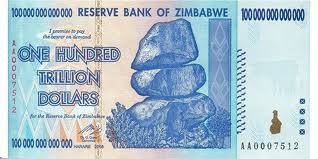
This report makes clear that many banks will collapse and countries too. Hyper inflation will destroy bank account and asset values. Starting with Greek default and Spain, but then continuing to France, UK and finally USA. Just look at the photo of the Greek ministry of finance below with files stored in shopping carts and plastic trash bags to see where Greece is today. Or read how $900M left Greek banks this Monday - what I would call a bank run.

This time I am expecting a coordinated central bank action that will involve most or all of the major central banks of the OECD: Japan, UK, US, and Europe.


One day, we will wake up to find some global message about the need for a coordinated response to a major crisis, and each of the central banks will be issuing some massive new amount of thin-air money. Of course the programs will be called something fancy that will require shortening to an acronym and will involve buying some form of debt (sovereign debt, but maybe also bank debt), and we’ll track this via central-bank balance-sheet expansion.

...


Given this environment of massive, rapidly-accelerating, and obfuscated risks, the prudent among us are undoubtedly wondering, How the heck is this going to play out? And how do I prepare for it?


I lay out my forecast for how low asset prices will sink before the central banks once again attempt to ride to the rescue with gargantuan liquidity measures.


But this next time won't work as it did in 2008, in my estimation. I see central banks being near the end of their ability to influence developments at this point. More liquidity will affect different asset classes differently, and for the first time raise real (and valid) concerns about the widescale debasement we are witnessing across the world's major fiat currencies.

Putting your capital into those resources best positioned to appreciate most as the result of money printing and hold or increase their purchasing power in such an environment should be a top priority for every concerned investor. [that is gold and productive land]

From ChrisMartenson.com


PS I have found Chris Martenson reports to be useful and practical and he doesn't get over hyped up about the coming changes. This email is a paid report so please don't pass it on.

Naked protest to TSA

May be naked protesters would stop the TSA madness! Seriously this article also points out that the "War on Terror" has saved several orders of magnitude less lives than died in car accidents in the same time period. What is the really reason for all the law changes in the last 10 years in the US?

Airport security is difficult enough. Depending on the country, that might mean shoes off, belts off, metallic items out of pockets, computer laptop(s) out of bags, iPads out of bag (sometimes - they can't quite figure out if it qualifies as a computer yet), jackets off, sometimes sweaters off, going through the scanner or getting a patdown (using the back of the hands only of course), boarding pass in hand, passport in hand, stand on one leg and bark like a dog... well, you get the idea.

Recently, one fellow traveling through Portland, Oregon in the US Pacific Northwest had had enough.

When taken away for "extra security measures", he stripped down to his birthday suit and made a political statement that, while ignored by much of the mainstream media it seems, is highly worth giving some serious thought to.

In today's feature, Dale Sinner, in his International Man debut, does just that.

Naked man at the airport

Probably the last thing anyone expects to see at the airport is a fat, naked middle-aged man. But that's just what passengers saw a couple of weeks ago at the airport in Portland, Oregon as they waited to go through security screening for the hour-and-a-half flight to San Jose, California.

Transportation Security Administration agents called John Brennan, 50, aside for "extra security measures." That was the last straw. He complied by stripping naked.

He reportedly asked, "Do I have anything illegal? Am I good to go through now?"

He wasn't good to go through, though.

Authorities arrested him for indecent exposure, restricted, then later restored his right to fly in and out of the state, and offered to drop the indecent exposure charge in exchange for an undisclosed amount of time in community service.

Brennan said no and is going to court.

The TSA responded by announcing an investigation into his "disruption" of the security check line. Brennan says he is being harassed.

A lot of Internet buzz has been focused on seeing a "disgusting, fat middle-aged man naked in the airport." But is that really the issue?

Brennan says it's not - 4th Amendment rights against unreasonable search and seizure are. I'd agree.

I was once called out for TSA "special screening" before boarding a similar flight. It was both infuriating and dumb as hell.

Some years back I was going through security at SEATAC airport for a flight from Seattle to Sacramento and I got called out for special screening for wearing a Japanese "jimbei" - a kind of casual, light summer jacket.

I've seen Americans in jackets like that, especially in Seattle. I didn't think it was any big deal.

It wasn't any big deal to the woman doing the X-raying. She could see there was nothing in my pockets and told me I didn't have to take the "jimbei" off - just go on through.

That set the TSA jackboot on full alert.

He screamed at me.

He ordered me to take it off, ordered me not to move, then stood himself directly in front of me - his nose perhaps two inches in front of mine.

He stared into my eyes with the fury and intense scrutiny you might expect if someone had concealed weapons or knives. I never imagined my slightly funny jacket would set off such alarm.

He turned to look at my US drivers license, carefully examined both sides and commented that I had a funny name. "Yep," I said.

He found nothing to justify detaining me further. He then simply said, firmly, "You have a nice trip," and that was the end of it.

I felt abused.

I was in a hurry and the episode could have easily made me miss my flight, so I cooperated in the abuse. Most Americans do.

But as time goes by, more and more people like naked Mr. Brennan are getting fed up and venting. It's easy to understand the anger.

Some have stripped naked as if to say, "Is this what you want?"

Others have gotten furious, shouted, and ultimately gotten arrested for speaking out a little too loudly. A little more than a week ago, a mother and her 4-year old daughter were detained in a ridiculous spectacle of an out-of-control government.

What is going on?

People my age remember being taught to hate the Soviet Union by showing how Americans were free to travel without being stopped at "internal checkpoints" while those sad Russians -- under the boot of communist dictatorship -- were scrutinized at every turn.

Our Saturday afternoons were spent watching World War II movies about Nazi Germany where people lived in fear of the words, "Papers please!"

How lucky we were to be American. How times have changed.

One wonders how big the threat of terrorism really is to justify all this heavy-handed domestic security.

Maybe a look at the numbers will show how real the risks are.

According to the Global Terrorism Database, 30 Americans died in terror incidents within US borders during the period between 2002 and 2011.

OK, that's not many. What about abroad?

Since 2005, 158 Americans have been killed in terror attacks abroad -- roughly 16 per year. Those were mostly in war zones like Iraq and Afghanistan.

That makes an American's chances of being killed in a terror attack worldwide about one in twenty million, on average, in any given year.

The risk is far less domestically.

Chances are you are far more likely to die in a car accident, die in a bathtub drowning, or even get struck by lightning than being killed in a terrorist attack.

Authorities will say that shows how effective anti-terrorism efforts have been. But does that justify the estimated $1 trillion spent on anti-terrorism in the US since 9/11 (which doesn't count spending in Iraq and Afghanistan)?

One analyst calculated that all the foiled terror plots in the US over the past ten years would have resulted in a maximum 2,300 potential deaths or about 230 per year. If true, that means the US government has spent $400,000,000 for every potential person saved.

Raise your hand if you believe any government would spend that much to "keep you safe."

Consider these other recent efforts to keep you safe:

  • The Department of Homeland Security just ordered 450 million rounds of special "hollow point" .40 caliber ammunition
  • Protestors can now be held indefinitely without trial and without legal representation
  • Unpaid taxes can prevent the issuance of a passport
  • The TSA can now make random car stops
  • Anyone taken to jail can now be strip-searched, even for unpaid traffic tickets

Sound like a bit of overkill to keep citizens safe against a 1 in 20,000,000 risk? Kind of leaves me wondering what the government has in mind.

It also leaves me wondering if we might not see a lot more reports of naked air passengers, 4-year olds under arrest and other authoritarian-inspired mayhem in coming days.

Papers, please.

Post your comments here.

Dale Gordon Sinner is a teacher and writer living in Chiba Prefecture, Japan.

From http://www.internationalman.com/global-perspectives/what-a-naked-computer-technician-says-about-airport-security

How to recognize when our financial ship has hit a Spanish iceberg

Here is an article explaining the process of how the Euro may collapse as Germany refuses to spend any more bailing out Spain. If the Euro does fall apart British and American banks will probably collapse due to their large exposure to Euro debt. And there is a large chance of sovereign default not just in Spain, Greece, Ireland but also in France, UK and USA. That will mean a combination of high inflation, spending cuts (health care, pensions etc) , confiscation of private pensions, extended bank closures


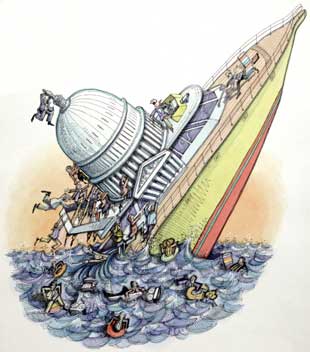
No one knows the timing of this - it is rather like being on the deck of the Titantic just after it hit the iceberg. For the first hour or so to the passengers all seemed fine. It was only the boat's builder who recognized that the ship was fatally hit and would sink. At first very few people wanted to take the inconvenience of getting in a lifeboat. But if you recall the movie at the end the ship started to shift suddenly and then there were not enough life boats for everyone and there was a panic.


The same thing happened in the Argentinean financial collapse in 2001 - at first very few people took action to get some money out of Argentinean banks or move it abroad. By the time it was clear to most people that there was a problem it was too late to save their bank account and pensions.... and you were not allowed to withdraw cash or move it abroad. I have talked with several Argentineans and read blogs and books about this and the few people there who were both aware and took action did much better than those who did not. And I don't just mean financially better, I mean emotionally better too because there were a lot of mental health problems, alcohol/drug abuse and suicides there in 2002 in the masses of people who felt betrayed and helpless.

I recommend taking some small steps for a "financial insurance plan" that I described in my previous blog post now while all appears relatively fine. If I am wrong and the boat stay afloat no harm done. It it does sink it will be sudden and messy and you will be very glad that you took action.

If Spain's Problems Are Solved... Why Are They Putting Together "Plan B"? 

The following is an excerpt from my latest client letter explaining why Spain is such a big deal and why when it defaults it's game over for the EU.

We have entered an extremely dangerous environment: one in which the primary prop for asset prices (Central Banks) are running out of ammunition. This will have profound consequences for all asset classes as well as the financial system at large.

This was the real problem with Central Bank responses to 2008 all along: by attempting to prolong a peaked economic/ credit cycle, they have set the stage for an even larger Crisis, one that will see the Central Banks themselves collapse along with numerous sovereign defaults.

These are the key take home points ALL investors must come to grips with:

  1. Going forward  the Easy Money props are going to be removed from beneath the market.
  2. Sovereign defaults are coming. Whether it's through hyperinflation, reneging on promised future social welfare / pension/ healthcare spending, or outright messy defaults (or various combinations of these) we will see most of the Western world defaulting on its debts in the coming years.


How soon all of this unfolds remains to be seen. The Multi-­Trillion Dollar Question is whether the markets realize that Central Banks are virtually powerless sooner rather than later.

By the look of things, it's coming relatively soon. Spain, which is now at the forefront of the Great Western Debt Default Collapse, has opted to seek funding from the mega-bailout fund, the European Stability Mechanism (ESM) rather than going directly to the ECB or the IMF.

The reasons for this are clear: the IMF doesn't have the funds (nor will it as the US won't fund a European bailout during a Presidential election year). And the ECB is now backed into a political corner with Germany.

However, as Spain has discovered, even ESM funding doesn't come without strings attached:

Germany Rejects Spain Banks Tapping Bailout Fund, Meister Says

Spain's rating downgrade at Standard & Poor's doesn't alter Germany's stance that banks can't have direct access to Europe's financial backstops, a senior lawmaker from Chancellor Angela Merkel's party said.

"The German position is absolutely strict," Michael Meister, the deputy caucus chairman of Merkel's Christian Democrats, said in a phone interview in Berlin. "And since such aid programs require unanimity, there's not going to be any change. All sorts of people can try to set things in motion, but Germany won't vote for it."

http://www.bloomberg.com/news/2012-04-27/germany-rejects-spain-banks-tapping-bailout-fund-meister-says.html

The ESM funding idea is really just Spain playing for time (the ESM doesn't actually have the funds to bail Spain out). But the fact that Germany is now making the ESM a political issue indicates the degree to which political relationships are breaking down in the EU. And once the political relationships break down... so will the Euro.

Indeed, Germany has no choice. If it decides to prop up Spain it will receive a ratings downgrade (something which France is about to experience anyway). Europe with a downgraded Germany is not a pretty sight.

Moreover, Germany's decision to prop up the Euro is finally beginning to arouse furor from the German population. In particular, the below story which reveals that Germany has in fact put German taxpayers on the hook for over €2 trillion in back-door EU rescue measures could be the proverbial tipping point that sends German voters over the edge.

German tempers boil over back-door euro rescues

Professor Hans-Werner Sinn, head of Germany's IFO Institute, said German taxpayers are facing a dangerous rise in credit risk from a plethora of bail-out schemes. "The euro-system is near explosion," he told Austria's Economics Academy on Thursday.

Dr Sinn said Germany is on the hook for much of the €2.1 trillion (£1.72 trillion) in rescue measures for EMU debtors- often by the backdoor- that will saddle Germans with ruinous losses one day.

Read more an here

How are the Earth's magnetic changes affecting you?

I am enjoying Cusco Peru a lot! I hired a personal Spanish teacher (who is called Luz) who is helping me improve my pronunciation and grammar - only S/ 15 (Approx $6) per hour :-) I am fluent enough for every day conversation and reading magazines and books (slowly!) and am now practicing my writing too. ¡He mastrando una classe de Kundalini Yoga todas las Lunes a la Healing House con 12 studentes - está muy linda!


I have had a several "colds" recently that didn't feel like a traditional cold - blocked sinuses, dizzy feeling around my head and shoulders, apathy, strange sleep and eating patterns. All cured when I got some energy healing. Have you been feeling strange recently? Tired, dizzy, headaches, "colds" that seem different from traditional sickness, feeling disoriented, apathy, loss of focus? You might have been self treating these symptoms with increases in addictive behaviors such as junk food, sugar, extra TV, coffee, chocolate, alcohol, drugs...


It might be that you are feeling the effects of the rapid changes in the Earth's magnetic field happening this year. It is not just the mass animal and bird deaths (many animals use the magnetic field for direction finding) but also humans are affected. This effect seems to have increased in the last few months and will probably increase during the year as the magnetic field changes more, with (according to the International Space Agency) solar activity sometimes deleting the Earth's magnetic field completely.

"A number of important findings already have emerged. For example, changes in the earth’s magnetic field are associated with changes in brain and nervous system activity; performance of athletic, memory and other tasks; sensitivity in a wide range of extrasensory perception experiments; synthesis of nutrients in plants and algae; the number of reported traffic violations and accidents; mortality from heart attacks and strokes; and incidence of depression and suicide. It’s interesting to note that changes in geomagnetic conditions affect the rhythms of the heart more strongly than all the physiological functions studied so far"

From http://www.glcoherence.org/monitoring-system/about-system.html


What to do? This article suggests tuning into the changes so that we can adapt ourselves to the new magnetic fields more easily. How to become more aware?

  • yoga
  • meditation
  • bodywork and energy healing
  • clearing old patterns and beliefs that keep you stuck, even clearing clutter!
  • sound therapy (eg singing bowls, Om chanting)
  • listen to your soul instead of tuning it out with addications
  • accept weird variations in food requirements, sleep and daily patterns that may occur as you adjust
  • live in the "now" and be flexible (great advice for all 2012 changes occurring!)

Good luck adapting and let me know what your experiences are?

Drug dealers, murders, accountants

As the US government goes deeper into debt the IRS is getting more aggressive. Usually accountants acused of white collar crime are not held in level 4 prisons with murders and drug dealers. But hey if the IRS needs to squeeze to get a conviction or the TSA needs to justify the investment in airport secuirty then what are a few civil rights?

IRS Inc.

March 14, 2012, Santiago, Chile: The current strategy of the IRS is to make the filing requirements for Americans living, investing, or holding assets overseas so complicated that it’s difficult to remain compliant. Misfile a form or missing a filing deadline, and the fines and penalties are severe, including prison time.

Dear Live and Invest Overseas Reader,

The writing has been on the wall for me since the TSA agent grabbed the Converse sneakers out of my then 2-year-old son's hands to put them through the X-ray machine as I tried to explain to my sobbing child that the big rude man wasn't stealing his favorite shoes.

Most of us have TSA horror stories. And we've all heard the far more horrible stories of extraordinary rendition by the CIA in the name of the War on Terror...the stories of torture by U.S. soldiers at Abu Ghraib prison in Iraq...the stories last weekend about the 16 Afghan villagers killed by an Army Ranger...

Those stories are sad and upsetting, but they're far away. Over the past six weeks or so, I've been watching as a story that's not nearly as horrific as 16 innocent people dying but that is much closer to home for me has been playing out.

If you've been reading my wife's and my dispatches for any time, you've heard of Chris Rusch. He's a U.S. tax attorney and a friend who, until early February, was living in Panama City. Chris traveled to Colombia with us in January to participate in our Live and Invest in Medellin Conference. He never made it back to Panama, because the IRS had him picked up on the jetway at Tocumen International Airport in Panama City. Chris was rerouted to the States where he remains today, still in custody. He has been held now for more than six weeks without being arraigned and without being formally charged of a crime.

For the first few weeks, we had some communication with Chris, who was allowed access to e-mail on a limited basis. He's since been relocated from the federal facility where he was initially held in Miami to a state prison in Arizona. Now the only information we receive is via Chris' father, who speaks with him by phone, as Chris no longer has e-mail capability.

The prison where he's being held is a level 3 or 4 state penitentiary. I didn't know much about the U.S. prison system before this either, but I've learned that this is not the kind of place where white-collar offenders are typically held, not before arraignment, not ever. It seems Chris is being held among the general Arizona prison population, the murderers, the rapists, etc., until he "cooperates."

I don't have any idea about what Chris did or didn't do, and my point here isn't to do with his guilt or innocence. My point is to do with due process...and big business.

The incremental degradation of the rights and freedoms guaranteed to every American by the U.S. constitution has continued now for decades...in the name of, first, the War on Drugs, then, the War on Terror...and, now, I guess, the War on Tax Guys...

Everything about the U.S. government today is a business, including, for example, airport security. The newest product for this business is those all-body scanners. The U.S. government conceived them, and now the U.S. government is consuming them. We poor travelers must succumb to them. We must give up any pretense of personal privacy and set aside any worry over personal health risks...or get left at the gate.

All in the name of security. Meantime, only the most naïve believe these things actually work. Take a look here for the story of one traveler who set out to debunk the idea that these scanners are a reliable part of any security protocol once and for all.

Airport security is an industry, a business...as is drug enforcement. Here I suggest a retooling. Rather than trying to make a business prohibiting the sale and the consumption of drugs altogether...make a business taxing said sale and consumption. As with cigarettes, as with alcohol. If someone wants to destroy his life over-using his drug of choice, Darwin's theory says let him. Meantime, the state could be generating good cash flow.

Airport security...drug enforcement...and the IRS. This, too, is a business. The current revenue strategy is all about the penalties being imposed on those who misfile or who fail to file the proper forms. A guy who, say, inherits a bank account from his non-American uncle in Europe with US$50,000 in it and doesn't realize he is supposed to report that account to the IRS can get hit with a US$100,000 fine...and jail time.

More forms. This is the current business agenda of the IRS. Institute more filing requirements and then invest in the staff to pay attention and chase down those who don't meet them. Generate press releases when you identify a big fish who hasn't filed or who hasn't complied in some other way and are able to squeeze a fine out of him. Increase awareness for your brand.

Within hours of nabbing Chris on the jetway in Panama, the IRS had issued a mass press release boasting of its triumph. Tax attorney arrested in Panama. Big headline.

Big business.

Lief Simon

from Living and Invest Overseas blog

Britain to record ALL Internet emails and phone calls

More of big brother, this time in UK.

(Reuters) - Britain is to allow one of its intelligence agencies to
monitor all phone calls, texts, emails and online activities in the
country to help tackle crime and militant attacks, the Interior Ministry
said on Sunday.

"It is vital that police and security services are able to obtain
communications data in certain circumstances to investigate serious
crime and terrorism and to protect the public," a Home Office spokesman
said.

The proposed law already has drawn strong criticism, from within the
ruling Conservative Party's own ranks, as an invasion of privacy and
personal rights.

"What the government hasn't explained is precisely why they intend to
eavesdrop on all of us without even going to a judge for a warrant,
which is what always used to happen," Member of Parliament David Davis
told BBC News.

"It is an unnecessary extension of the ability of the state to snoop on
ordinary people," he said.

New legislation is expected to be announced in the legislative
agenda-setting speech given by the queen in May.

Currently, British agencies can monitor calls and e-mails of specific
individuals who may be under investigation after obtaining ministerial
approval, but expanding that to all citizens is certain to enrage civil
liberties campaigners.

Internet companies would be required to install hardware which would
allow the Government Communications Headquarters (GCHQ), referred to as
Britain's electronic 'listening' agency, to gain real-time access to
communications data.

The new law would not allow GCHQ to access the content of emails, calls
or messages without a warrant, but it would allow it to trace who an
individual or group was in contact with, how frequently they
communicated and for how long.

The Sunday Times newspaper, which first reported the story, said some
details of the proposals were given to members of the Britain's Internet
Service Providers' Association last month.

"As set out in the Strategic Defence and Security Review we will
legislate as soon as parliamentary time allows to ensure that the use of
communications data is compatible with the government's approach to
civil liberties," the Home Office spokesman said.

Any proposed legislation changes are likely to face stiff opposition in
both houses of the British Parliament.

A similar proposal was considered by the then-ruling Labour party in
2006 but was abandoned in the face of fierce opposition by the
Conservatives and Liberal Democrats, who are junior partners in the
ruling coalition.

The proposed legislation could reflect the U.S. Patriot Act,
controversially introduced six weeks after September 11 in 2001, to
expand the government's authority to monitor the communications activity
of its citizens.


from
http://www.reuters.com/article/2012/04/01/us-britain-monitoring-idUSBRE8300KD20120401

9 steps to prepare for a financial crisis - your "crisis insurance"

This is from a letter to my parents in UK - I think it is helpful advice to anyone in UK, Europe and USA right now.


You asked about what good places for money are in a crisis. Here are suggestions on money backup plan based on what happened in 1930s in USA (and I think UK at same time) and in Argentina in 2002. Or just look at Greece today. Possible consequences are:

  • currency devaluation of 50% or more,
  • high inflation (100%+),
  • high unemployment (30%+)
  • food shortages,
  • social unrest/protests/strikes
  • banks closed for extended "holiday"/ATMs closed for months
  • currency controls enforced so you can't take money out of the country
  • pensions and investments forcibly converted to government bonds "for your own safety"


Based on many articles I have read and people I have talked to I think there is a high probability (>50%) that there will be a major financial crisis this year in USA, Europe and UK. I think within the next 6 months. Currently governments and banks are doing all they can to delay when this will happen so things may on the surface appear normal. If you know anything of catastrophe theory you know that a system can flip from one stable state to a lower one very quickly and "unexpectedly" after years of appearing not to change at all. W


When similar crises have happened in the past they occurred within a day or two so it is better to prepare ahead of time because if it actually happens you won't have time for this stuff. Hopefully you won't have to use any of this - think of it like an insurance policy... you don't like to think about it, don't like paying the premium and if a crisis does happen you are very glad you got it.


1. Have a month's expenses as cash because ATMs/Visa may not be working if there is a crisis.


2. Move some money from accounts at large bank/building society to a small local bank/building society/credit union because these have less exposure to Euro/Dollar default. It is best not to have all your eggs in one basket anyway...


3. Buy a few ounces of gold coins (modern ones not old ones that have higher price due to rarity) in 1/10 th once size. (1/10ths cost a bit more than 1 ounce but are more convenient to convert one at a time for cash during high inflation.) There are several coin shops in London (and across USA) that sell these or you may be able to get through the post. Store safely in house or garden (and keep a record of where you put). Do not tell any other people about this or your cash - people talk and it may attract thieves. A bank safety deposit box is not a good idea if the banks are closed.... Also governments have take the contents of these boxes in the past during crisis.


4. Move some money to stronger currency eg Singapore Dollar, Australian dollar, Chileano Peso, Chinese yuan preferable in an account held outside UK/Europe/USA. I believe that HSBC bank will let you open a Hong Kong account if you go to one of their UK or US branches with documents (passport and utility bill). They may try to get you to open UK/US account but it is possible to open HK one there and I know people who have done so after persisting. I know that HSBC will let you hold your account in various foreign currencies, you get an ATM/Visa card that you can use in UK or anywhere else in world and you can access your account online. This both protects your money from decline in UKP and protects you if UK/US banks accounts are closed for an extended time.

Also on a practical level

5. Have a month's supply of food (I think you already have this)


6. Have a way to purify water (filter or clorine bleach)


7. Have some flashlights or candles in case power goes out (remember the 1970s power cuts in UK?)


8. Keep petrol tank at least half full (remember petrol lines in 1970s)


9. Renew passport now - you can not travel if you have less than 6 months left on passport.


The main issue people have with this kind of change is denial. Most people in German in the 1923 inflation could not believe it was happening so did nothing and lost all their money. Today in Greece 75% of people have not taken their money out of Greek banks that have a high risk of collapse. In Argentina in 2002 most people did not act before they had lost 75% of their money and spent 5 months with no access to their accounts or ATMs. The practical steps are easy - it is dealing with the emotional reaction and denial that is harder.


In every case (but one) in the past 2000 years when government and private debt became too large to service there either was a direct default or an indirect default by massive inflation with the kind of consequences I listed above. I don't expect this case to be any different.

Corruption contest: China vs US - are we ahead?

Excellent analysis of China and America economic, political and futures compared in this article (exerts below)

The rise of China surely ranks among the most important world developments of the last 100 years. With America still trapped in its fifth year of economic hardship, and the Chinese economy poised to surpass our own before the end of this decade, China looms very large on the horizon. We are living in the early years of what journalists once dubbed “The Pacific Century,” 

But does the Chinese giant have feet of clay? In a recently published book, Why Nations Fail, economists Daron Acemoglu and James A. Robinson characterize China’s ruling elites as “extractive”—parasitic and corrupt—and predict that Chinese economic growth will soon falter and decline, while America’s “inclusive” governing institutions have taken us from strength to strength. They argue that a country governed as a one-party state, without the free media or checks and balances of our own democratic system, cannot long prosper in the modern world. The glowing tributes this book has received from a vast array of America’s most prominent public intellectuals, including six Nobel laureates in economics, testifies to the widespread popularity of this optimistic message.

Yet do the facts about China and America really warrant this conclusion? 

China Shakes the World

By the late 1970s, three decades of Communist central planning had managed to increase China’s production at a respectable rate, but with tremendous fits and starts, and often at a terrible cost: 35 million or more Chinese had starved to death during the disastrous 1959–1961 famine caused by Mao’s forced industrialization policy of the Great Leap Forward.

China’s population had also grown very rapidly during this period, so the typical standard of living had improved only slightly, perhaps 2 percent per year between 1958 and 1978, and this from an extremely low base. Adjusted for purchasing power, most Chinese in 1980 had an income 60–70 percent below that of the citizens in other major Third World countries such as Indonesia, Nigeria, Pakistan, and Kenya, none of which were considered great economic success stories. In those days, even Haitians were far wealthier than Chinese.

All this began to change very rapidly once Deng Xiaoping initiated his free-market reforms in 1978, first throughout the countryside and eventually in the smaller industrial enterprises of the coastal provinces. By 1985, The Economist ran a cover story praising China’s 700,000,000 peasants for having doubled their agricultural production in just seven years, an achievement almost unprecedented in world history. Meanwhile, China’s newly adopted one-child policy, despite its considerable unpopularity, had sharply reduced population growth rates in a country possessing relatively little arable land.

A combination of slowing population growth and rapidly accelerating economic output has obvious implications for national prosperity. During the three decades to 2010, China achieved perhaps the most rapid sustained rate of economic development in the history of the human species, with its real economy growing almost 40-fold between 1978 and 2010. In 1978, America’s economy was 15 times larger, but according to most international estimates, China is now set to surpass America’s total economic output within just another few years.

China’s economic progress is especially impressive when matched against historical parallels. Between 1870 and 1900, America enjoyed unprecedented industrial expansion, such that even Karl Marx and his followers began to doubt that a Communist revolution would be necessary or even possible in a country whose people were achieving such widely shared prosperity through capitalistic expansion. During those 30 years America’s real per capita income grew by 100 percent. But over the last 30 years, real per capita income in China has grown by more than 1,300 percent.

Over the last decade alone, China quadrupled its industrial output, which is now comparable to that of the U.S. In the crucial sector of automobiles, China raised its production ninefold, from 2 million cars in 2000 to 18 million in 2010, a figure now greater than the combined totals for America and Japan. China accounted for fully 85 percent of the total world increase in auto manufacturing during that decade.

... And although America originally pioneered the Human Genome Project, the Beijing Genomics Institute (BGI) today probably stands as the world leader in that enormously important emerging scientific field.

...

Does China’s rise necessarily imply America’s decline? Not at all: human economic progress is not a zero-sum game. Under the right circumstances, the rapid development of one large country should tend to improve living standards for the rest of the world.

...


Social Costs of a Rapid Rise

Transforming a country in little more than a single generation from a land of nearly a billion peasants to one of nearly a billion city-dwellers is no easy task, and such a breakneck pace of industrial and economic development inevitably leads to substantial social costs. Chinese urban pollution is among the worst in the world, and traffic is rapidly heading toward that same point. China now contains the second largest number of billionaires after America, together with more than a million dollar-millionaires, and although many of these individuals came by their fortunes honestly, many others did not. Official corruption is a leading source of popular resentment against the various levels of Chinese government, ranging from local village councils to the highest officials in Beijing.

But we must maintain a proper sense of proportion. As someone who grew up in Los Angeles when it still had the most notorious smog in America, I recognize that such trends can be reversed with time and money, and indeed the Chinese government has expressed intense interest in the emerging technology of non-polluting electric cars. Rapidly growing national wealth can be deployed to solve many problems.

Similarly, plutocrats who grow rich through friends in high places or even outright corruption are easier to tolerate when a rising tide is rapidly lifting all boats. Ordinary Chinese workers have increased their real income by well over 1,000 percent in recent decades, while the corresponding figure for most American workers has been close to zero. If typical American wages were doubling every decade, there would be far less anger in our own society directed against the “One Percent.” Indeed, under the standard GINI index used to measure wealth inequality, China’s score is not particularly high, being roughly the same as that of the United States, though certainly indicating greater inequality than most of the social democracies of Western Europe.

Much of the Tiananmen protest had been driven by popular outrage at government corruption, and certainly there have been additional major scandals in recent years, often heavily splashed across the pages of America’s leading newspapers. But a closer examination paints a more nuanced picture, especially when contrasted with America’s own situation.

For example, over the last few years one of the most ambitious Chinese projects has been a plan to create the world’s largest and most advanced network of high-speed rail transport, an effort that absorbed a remarkable $200 billion of government investment. The result was the construction of over 6,000 miles of track, a total probably now greater than that of all the world’s other nations combined. .... based on the published accounts, it appears that the funds diverted amounted to perhaps as little as 0.2 percent of the total, with the remaining 99.8 percent generally spent as intended. So serious corruption notwithstanding, the project succeeded and China does indeed now possess the world’s largest and most advanced network of high-speed rail, constructed almost entirely in the last five or six years.

Meanwhile, America has no high-speed rail whatsoever, despite decades of debate and vast amounts of time and money spent on lobbying, hearings, political campaigns, planning efforts, and environmental-impact reports. China’s high-speed rail system may be far from perfect, but it actually exists, while America’s does not. ...

All of this follows the pattern of Lee Kwan Yew’s mixed-development model, combining state socialism and free enterprise, which raised Singapore’s people from the desperate, abject poverty of 1945 to a standard of living now considerably higher than that of most Europeans or Americans, including a per capita GDP almost $12,000 above that of the United States. Obviously, implementing such a program for the world’s largest population and on a continental scale is far more challenging than doing so in a tiny city-state with a population of a few million and inherited British colonial institutions, but so far China has done very well in confounding its skeptics.

America’s Economic Decline

These facts do not provide much evidence for the thesis in Why Nations Fail that China’s leaders constitute a self-serving and venal “extractive” elite. Unfortunately, such indications seem far more apparent when we direct our gaze inward, toward the recent economic and social trajectory of our own country

Against the backdrop of remarkable Chinese progress, America mostly presents a very gloomy picture. Certainly America’s top engineers and entrepreneurs have created many of the world’s most important technologies, sometimes becoming enormously wealthy in the process. But these economic successes are not typical nor have their benefits been widely distributed. Over the last 40 years, a large majority of American workers have seen their real incomes stagnate or decline.

Meanwhile, the rapid concentration of American wealth continues apace: the richest 1 percent of America’s population now holds as much net wealth as the bottom 90–95 percent, and these trend may even be accelerating. A recent study revealed that during our supposed recovery of the last couple of years, 93 percent of the total increase in national income went to the top 1 percent, with an astonishing 37 percent being captured by just the wealthiest 0.01 percent of the population, 15,000 households in a nation of well over 300 million people.

Evidence for the long-term decline in our economic circumstances is most apparent when we consider the situation of younger Americans. ... barely half of 18- to 24-year-old Americans are currently employed, the lowest level since 1948 ...

The total outstanding amount of non-dischargeable student-loan debt has crossed the trillion-dollar mark, now surpassing the combined total of credit-card and auto-loan debt—... A huge swath of America’s younger generation seems completely impoverished, and likely to remain so.

International trade statistics, meanwhile, demonstrate that although Apple and Google are doing quite well, our overall economy is not. For many years now our largest goods export has been government IOUs, whose dollar value has sometimes been greater than that of the next ten categories combined. At some point, perhaps sooner than we think, the rest of the world will lose its appetite for this non-functional product, and our currency will collapse, together with our standard of living. Similar Cassandra-like warnings were issued for years about the housing bubble or the profligacy of the Greek government, and were proven false year after year until one day they suddenly became true.

China rises while America falls, but are there major causal connections between these two concurrent trends now reshaping the future of our world? Not that I can see. American politicians and pundits are naturally fearful of taking on the fierce special interest groups that dominate their political universe, so they often seek an external scapegoat to explicate the misery of their constituents, sometimes choosing to focus on China. But this is merely political theater for the ignorant and the gullible.

...It is always easier for a nation to point an accusing finger at foreigners rather than honestly admit that almost all its terrible problems are essentially self-inflicted.

Decay of Constitutional Democracy

The central theme of Why Nations Fail is that political institutions and the behavior of ruling elites largely determine the economic success or failure of countries. If most Americans have experienced virtually no economic gains for decades, perhaps we should cast our gaze at these factors in our own society.

Our elites boast about the greatness of our constitutional democracy, the wondrous human rights we enjoy, the freedom and rule of law that have long made America a light unto the nations of the world and a spiritual draw for oppressed peoples everywhere, including China itself. But are these claims actually correct? They often stack up very strangely when they appear in the opinion pages of our major newspapers, coming just after the news reporting, whose facts tell a very different story.

Just last year, the Obama administration initiated a massive months-long bombing campaign against the duly recognized government of Libya on “humanitarian” grounds, then argued with a straight face that a military effort comprising hundreds of bombing sorties and over a billion dollars in combat costs did not actually constitute “warfare,” and hence was completely exempt from the established provisions of the Congressional War Powers Act. A few months later, Congress overwhelmingly passed and President Obama signed the National Defense Authorization Act, granting the president power to permanently imprison without trial or charges any American whom he classifies as a national-security threat based on his own judgment and secret evidence. When we consider that American society has experienced virtually no domestic terrorism during the past decade, we must wonder how long our remaining constitutional liberties would survive if we were facing frequent real-life attacks by an actual terrorist underground, such as had been the case for many years with the IRA in Britain, ETA in Spain, or the Red Brigades in Italy.

Most recently, President Obama and Attorney General Eric Holder have claimed the inherent right of an American president to summarily execute anyone anywhere in the world, American citizen or not, whom White House advisors have privately decided was a “bad person.” While it is certainly true that major world governments have occasionally assassinated their political enemies abroad, I have never before heard these dark deeds publicly proclaimed as legitimate and aboveboard. Certainly if the governments of Russia or China, let alone Iran, declared their inherent right to kill anyone anywhere in the world whom they didn’t like, our media pundits would immediately blast these statements as proof of their total criminal insanity.

Many of these negative ideological trends have been absorbed and accepted by the popular culture and much of the American public. Over the last decade one of the highest-rated shows on American television was “24”, ... ...representing a popular weekly glorification of graphic government torture on behalf of the greater good.

Now soft-headed protestations to the contrary, most governments around the world have at least occasionally practiced torture, especially when combating popular insurgencies, and some of the more brutal regimes, including Stalinist Russia and Nazi Germany, even professionalized the process. But such dark deeds done in secret were always vigorously denied in public, and the popular films and other media of Stalin’s Soviet Union invariably featured pure-hearted workers and peasants bravely doing their honorable and patriotic duty for the Motherland, rather than the terrible torments being daily inflicted in the cellars of the Lubyanka prison. Throughout all of modern history, I am not aware of a single even semi-civilized country that publicly celebrated the activities of its professional government torturers in the popular media. Certainly such sentiments would have been totally abhorrent and unthinkable in the “conservative Hollywood” of the Cold War 1950s.

Given these facts, we should hardly be surprised that international surveys over the past decade have regularly ranked America as the world’s most hated major nation, a remarkable achievement given the dominant global role of American media and entertainment and also the enormous international sympathy that initially flowed to our country following the 9/11 attacks.


An Emerging One-Party State

So far at least, these extra-constitutional and often brutal methods have not been directed toward controlling America’s own political system; we remain a democracy rather than a dictatorship. But does our current system actually possess the central feature of a true democracy, namely a high degree of popular influence over major government policies? Here the evidence seems more ambiguous.

With two ruinous wars and a financial collapse to his record, George W. Bush was widely regarded as one of the most disastrous presidents in American history, and at times his public approval numbers sank to the lowest levels ever measured. The sweeping victory of his successor, Barack Obama, represented more a repudiation of Bush and his policies than anything else, ...

Yet almost none of these reversals took place. Instead, the continuity of administration policy has been so complete and so obvious that many critics now routinely speak of the Bush/Obama administration.

...Obama promised that he would move to end Bush’s futile Iraq War immediately upon taking office, but instead large American forces remained in place for years ... In particular, the continuity of top officials has been remarkable. As Bush’s second defense secretary, Robert Gates ...Timothy Geithner had been one of Bush’s most senior financial appointments ... now Treasury secretary ... Bush wars and bailouts became Obama wars and bailouts. The American public voted for an anti-Bush, but got Bush’s third term instead.

...

But if our government policies are so broadly unpopular, why are we unable to change them through the sacred power of the vote? The answer is that America’s system of government has increasingly morphed from being a representative democracy to becoming something closer to a mixture of plutocracy and mediacracy, with elections almost entirely determined by money and media, not necessarily in that order. Political leaders are made or broken depending on whether they receive the cash and visibility needed to win office.

National campaigns increasingly seem sordid reality shows for second-rate political celebrities, while our country continues along its path toward multiple looming calamities. Candidates who depart from the script or deviate from the elite D.C. consensus regarding wars or bailouts—notably a principled ideologue such as Ron Paul—are routinely stigmatized in the media as dangerous extremists or even entirely airbrushed out of campaign news coverage, as has been humorously highlighted by comedian Jon Stewart.

[the cost of the] Iraq War at $3 trillion, representing over one-fifth of our entire accumulated national debt, or almost $30,000 per American household. ...

And we suffer other costs as well. A recent New York Times story described the morale-building visit of Secretary of Defense Leon Panetta to our forces in Afghanistan and noted that all American troops had been required to surrender their weapons before attending his speech and none were allowed to remain armed in his vicinity. Such a command decision seems almost unprecedented in American history and does not reflect well upon the perceived state of our military morale.

Future historians may eventually regard these two failed wars, fought for entirely irrational reasons, as the proximate cause of America’s financial and political collapse, representing the historical bookend to our World War II victory, which originally established American global dominance.


Our Extractive Elites 

When parasitic elites govern a society along “extractive” lines, a central feature is the massive upward flow of extracted wealth, regardless of any contrary laws or regulations. Certainly America has experienced an enormous growth of officially tolerated corruption as our political system has increasingly consolidated into a one-party state controlled by a unified media-plutocracy.

Consider the late 2011 collapse of MF Global, a midsize but highly reputable brokerage firm. Although this debacle was far smaller than the Lehman bankruptcy or the Enron fraud, it effectively illustrates the incestuous activities of America’s overlapping elites. Just a year earlier, Jon Corzine had been installed as CEO, following his terms as Democratic governor and U.S. senator from New Jersey and his previous career as CEO of Goldman Sachs. Perhaps no other American had such a combination of stellar political and financial credentials on his resume. Soon after taking the reins, Corzine decided to boost his company’s profits by betting its entire capital and more against the possibility that any European countries might default on their national debts. When he lost that bet, his multi-billion-dollar firm tumbled into bankruptcy.

At this point, the story moves from a commonplace tale of Wall Street arrogance and greed into something out of the Twilight Zone, or perhaps Monty Python. The major newspapers began reporting that customer funds, eventually said to total $1.6 billion, had mysteriously disappeared during the collapse, and no one could determine what had become of them, a very strange claim in our age of massively computerized financial records. Weeks and eventually months passed, tens of millions of dollars were spent on armies of investigators and forensic accountants, but all those customer funds stayed “missing,” while the elite media covered this bizarre situation in the most gingerly possible fashion. As an example, a front page Wall Street Journal story on February 23, 2012 suggested that after so many months, there seemed little likelihood that the disappeared customer funds might ever reappear, but also emphasized that absolutely no one was being accused of any wrongdoing. Presumably the journalists were suggesting that the $1.6 billion dollars of customer money had simply walked out the door on its own two feet.

Stories like this give the lie to the endless boasts of our politicians and business pundits that America’s financial system is the most transparent and least corrupt in today’s world. Certainly America is not unique in the existence of long-term corporate fraud, as was recently shown in the fall of Japan’s Olympus Corporation following the discovery of more than a billion dollars in long-hidden investment losses. But when we consider the largest corporate collapses of the last decade that were substantially due to fraud, nearly all the names are American: WorldCom, Enron, Tyco, Global Crossing, and Adelphia. And this list leaves out all the American financial institutions destroyed by the financial meltdown—such as Lehman, Bear Stearns, Merrill Lynch, Washington Mutual, and Wachovia—and the many trillions of dollars in American homeowner equity and top-rated MBS securities which evaporated during that process. Meanwhile, the largest and longest Ponzi Scheme in world history, that of Bernie Madoff, had survived for decades under the very nose of the SEC, despite a long series of detailed warnings and complaints. The second largest such fraud, that of Allen R. Stanford, also bears the label “Made in the USA.”

Some of the sources of Chinese success and American decay are not entirely mysterious. As it happens, the typical professional background of a member of China’s political elite is engineering; they were taught to build things. Meanwhile, a remarkable fraction of America’s political leadership class attended law school, where they were trained to argue effectively and to manipulate. Thus, we should not be greatly surprised that while China’s leaders tend to build, America’s leaders seem to prefer endless manipulation, whether of words, money, or people.

How corrupt is the American society fashioned by our current ruling elites? ...However, although American micro-corruption is rare, we seem to suffer from appalling levels of macro-corruption, situations in which our various ruling elites squander or misappropriate tens or even hundreds of billions of dollars of our national wealth, sometimes doing so just barely on one side of technical legality and sometimes on the other.

Sweden is among the cleanest societies in Europe, while Sicily is perhaps the most corrupt. But suppose a large clan of ruthless Sicilian Mafiosi moved to Sweden and somehow managed to gain control of its government. On a day-to-day basis, little would change, with Swedish traffic policemen and building inspectors performing their duties with the same sort of incorruptible efficiency as before, and I suspect that Sweden’s Transparency International rankings would scarcely decline. But meanwhile, a large fraction of Sweden’s accumulated national wealth might gradually be stolen and transferred to secret Cayman Islands bank accounts, or invested in Latin American drug cartels, and eventually the entire plundered economy would collapse.

A society’s media and academic organs constitute the sensory apparatus and central nervous system of its body politic, and if the information these provide is seriously misleading, looming dangers may fester and grow. A media and academy that are highly corrupt or dishonest constitute a deadly national peril. And although the political leadership of undemocratic China might dearly wish to hide all its major mistakes, its crude propaganda machinery often fails at this self-destructive task. But America’s own societal information system is vastly more skilled and experienced in shaping reality to meet the needs of business and government leaders, and this very success does tremendous damage to our country.

Perhaps Americ

Does Classic Science Fiction become Current Reality Fact?

Interesting article on how science fiction has become today's facts on the ground. With looks at our economic system, the military and war, education debt slaves, prison growth, climate change and system change by non-violent means

Welcome to the 2012 Hunger Games
Sending Debt Peonage, Poverty, and Freaky Weather Into the Arena

By Rebecca Solnit

[Science fiction]  books were supposed to be about the future, but they always turned out to be very much about this very moment.

Some of them -- Robert Heinlein’s Stranger in a Strange Land -- were comically of their time: that novel’s vision of the good life seemed to owe an awful lot to the Playboy Mansion in its prime, only with telepathy and being nice added in. Frank Herbert’s Dune had similarly sixties social mores, but its vision of an intergalactic world of disciplined desert jihadis and a great game for the substance that made all long-distance transit possible is even more relevant now.  Think: drug cartels meet the oil industry in the deep desert.

We now live in a world that is wilder than a lot of science fiction from my youth. My phone is 58 times faster than IBM’s fastest mainframe computer in 1964 (calculates my older brother Steve) and more powerful than the computers on the Apollo spaceship we landed on the moon in 1969 (adds my nephew Jason). Though we never got the promised jetpacks and the Martians were a bust, we do live in a time when genetic engineers use jellyfish genes to make mammals glow in the dark and nerds in southern Nevada kill people in Pakistan and Afghanistan with unmanned drones.  Anyone who time-traveled from the sixties would be astonished by our age, for its wonders and its horrors and its profound social changes. But science fiction is about the present more than the future, and we do have a new science fiction trilogy that’s perfect for this very moment.

Sacrificing the Young in the Arenas of Capital

The Hunger Games, Suzanne Collins’s bestselling young-adult novel and top-grossing blockbuster movie, is all about this very moment in so many ways. For those of you hiding out deep in the woods, it’s set in a dystopian future North America, a continent divided into downtrodden, fearful districts ruled by a decadent, luxurious oligarchy in the Capitol. Supposedly to punish the districts for an uprising 74 years ago, but really to provide Roman-style blood and circuses to intimidate and distract, the Capitol requires each district to provide two adolescent Tributes, drawn by lottery each year, to compete in the gladiatorial Hunger Games broadcast across the nation.  

...
But while the Capitol is portrayed as brutal for annually sacrificing 23 teenagers from the Districts, what about our own Capitol in the District of Columbia? It has a war or two on, if you hadn’t noticed.

In Iraq, 4,486 mostly young Americans died.  If you want to count Iraqis (which you should indeed want to do), the deaths of babies, children, grandmothers, young men, and others total more than 106,000 by the most conservative count, hundreds of thousands by others. Even the lowest numbers represent enough kill to fill nearly 5,000 years of Hunger Games.  

Our wartime carnage has been on a grand scale, but it hasn’t been on television in any meaningful way; it’s generally been semi-hidden by most of the American media and the government, which censored images of returning coffins, corpses, civilian casualties, and anything else uncomfortable (though in our science-fiction era when every phone is potentially a video camera, the leakage has still been colossal). Most of us did a good job of being distracted by other things -- including reality TV, of course.  The US Ambassador and military commander in Afghanistan were furious not that our soldiers struck jokey poses with severed limbs, but that the Los Angeles Times dared to publish them last month. 

The Return of Debt Peonage

In The Hunger Games, kids in poor families take out extra chances in their District lottery -- that is, extra chances to die -- in return for extra food rations; in ours, poor kids enlist in the military to feed their families and maybe escape economic doom. Many are seduced by military recruiters who stalk them in high school with promises as slippery as those the slave trade uses to recruit poor young women for sex work abroad.

And then there’s another form of debt peonage that is far more widespread in our strange and ever-changing land: student loans. The young are constantly told that only a college education can give them a decent future. Then they’re told that, to pay for it, they need to go into debt -- usually into five figures, sometimes well into six. And these debts are, in turn, governed by special laws that don’t allow you to declare bankruptcy -- no matter what.  In other words, they are guaranteed to follow you all your life.... not so dissimilar, that is, from the debts sharecroppers and workers in company towns used to incur.


“Since 1978, the price of tuition at U.S. colleges has increased over 900%, 650 points above inflation."

...

Of course, we do have one arena in which meals are guaranteed, and the population there keeps growing. Six million Americans live there, and it often does get gladiatorial inside. It’s called prison, and we have the highest percentage of prisoners per population in the world, higher than in the USSR gulags under Stalin. Half of them are there for drug offenses, 80% of those for simple possession.

Which, as I’m sure you’ve noticed, hasn’t stopped the flow of drugs meant to numb the pain we’re so good at creating here.  We should create a measure for Gross National Suffering (GNS) before we even think about the Gross National Happiness they measure in Bhutan.

In the Shadow of 900 Tornados


There were 160 tornados reported on March 2nd of this year. Remember that, in April of 2011, 900 tornadoes were ripping up interior United States, and this April was similarly volatile.  Remember the unprecedented wildfires, the catastrophic floods, the heat waves, the bizarrely hot North American January and other oddities? That’s science fiction of the scariest sort, and we’re in it. Or on it, on the crazy new planet we’ve made ourselves. Here in the USA sector of Eaarth in the year 2012, 15,000 high-temperature records were broken in March alone, and summer is yet to come. A town in north-central Texas hit 111 degrees -- in April! What turbulent planet is this?

One grain of good news: a lot of us, even in this country, finally seem to be of aware of the strangeness of the planet we’re now on. As the New York Times reported, a new survey “shows that a large majority of Americans believe that this year’s unusually warm winter, last year’s blistering summer, and some other weather disasters were probably made worse by global warming. And by a 2-to-1 margin, the public says the weather has been getting worse, rather than better, in recent years.”

...

Revolution 2012

...

Violence is not power, as Jonathan Schell makes strikingly clear in The Unconquerable World, it’s what the state uses when we are not otherwise under control. In addition, when we speak of “nonviolence” as an alternative to violence, we can’t help but underestimate our own power.  That word, unfortunately, sounds like it’s describing an absence, a polite refraining from action, when what’s at stake -- as demonstrators around the world proved last year -- is a force to be reckoned with; so call it “people power” instead.

When we come together as civil society to exercise this power, regimes tremble and history is made. Not instantly and not exactly according to plan, but who ever expected that?

Still, many regimes have been toppled by this power, and the capacity to do so is ours in the present.  As Erica Chenoweth and Maria Stephan point out in their recent Why Civil Resistance Works: The Strategic Logic of Nonviolent Conflict, since 1900 people-power campaigns have been successful in achieving regime change more than twice as often as violent campaigns.

...last week tiny Occupy Norman (Oklahoma) announced that it “had won a major battle”: their city is moving all its money out of Bank of America into a local bank. Last fall’s Move Your Money campaign included city money from the outset and quiet victories like this could begin to reshape our economic landscape. Activism in the streets is so intimidating that next month's G8 Summit scheduled for Chicago will hole up at Camp David instead.

...
So we need one more tool in our arsenal, and that’s a picture of what we want, of what a better world looks like. McKibben’s Eaarth and Deep Economy offer such a picture, as does William Morris’s News from Nowhere, even 120-odd years later, but we won’t get that from The Hunger Games, which, for all its thrilling, subversive, and surly delights, is all dystopia all the way home. We may still get it, however, on our stranger-than-fiction planet.
Rebecca Solnit grew up in California public libraries and is thrilled to be revisiting them all over the state as part of the Cal Humanities California Reads project, which is now featuring five books, including her A Paradise Built in Hell: The Extraordinary Communities That Arise in Disaster. Ursula K. LeGuin’s Earthsea books remain her favorite young-adult fantasy series, even though she found The Hunger Games trilogy irresistible.
Above exerts from full article

What can we learn from the SU collapse?

When the Soviet Union collapsed Dmitry Orlov was there observing how the different systems shiftted. He has since lived in the US and in this interesting slideshow he compares the Collapse of the SU empire to the coming collapse of the US empire. Dmitry also has a book out about this called  "Reinventing Collapse"


Orlov has many penetrating insights, couched in his dark humor. Particularly striking is the strong case he makes that the peoples of the USSR were actually better prepared for a collapse because

  • they had learned to be more self-reliant
  • many crucial functions (like housing and transportation) were taken care of by the state sector which was more stable than a private sector would have been.
  • more family and social networks of help

Shipping index is front runner of Great Depression 2.0

If the global economy is not heading for a recession, then why is global shipping slowing down so dramatically?  The Baltic Dry Index of shipping volume went down before 2008 crisis and is down again now. Prices to bulk ship cargo have dropped to zero or in some cases below (one shipping company is paying clients to ship with them just to keep the engines turning because after 3 months of inactivity large ships start to fall apart).


I would recommend do some preparation now for a possible deep and long Great Depression to compare to the one in 1929 - 1939. Some suggestions:

  • take money out of stocks and bonds
  • take money out of large banks such of Bank of America and put in credit union
  • put some money in physical gold that you keep hold of
  • stock up on storagable food
  • have a way to purify water for several days
  • Get a second passport
  • Improve your skills set
  • Improve your social network and community
  • Have a way to grow some food if needed
  • Consider getting a handgun and dog

How can we identify American Terrorists?

According to the new DHS report, the following are some of the beliefs and ideologies of American terrorists.... do any of these apply to you or people you know?

-"fiercely nationalistic (as opposed to universal and international in orientation)"

-"anti-global"

-"suspicious of centralized federal authority"

-"reverent of individual liberty"

-"believe in conspiracy theories"

-"a belief that one’s personal and/or national “way of life” is under attack"

-"a belief in the need to be prepared for an attack either by participating in paramilitary preparations and training or survivalism"

-"impose strict religious tenets or laws on society (fundamentalists)"

-"insert religion into the political sphere"

-"those who seek to politicize religion"

-"supported political movements for autonomy"

-"anti-abortion"

-"anti-Catholic"

-"anti-nuclear"

All of the above are direct quotes from the report.

Do any of those beliefs apply to you?

Does your own government now believe that you are a potential terrorist?

Read more here

Are you Suspicious?

You too can report on your fellow citizens for suspicious activities (or if your prefer you can be reported by someone else). What kind of activity counts as suspicious? According to the FBI  the following are included:

"Are overly concerned about privacy, attempts to shield the screen from view of others"

Look, if I am doing some online banking or am composing an email to a friend I don't want someone peeking at my screen.  Aren't most Americans "concerned about privacy" and don't most people want to keep their Internet activity to themselves?

"Always pay cash or use credit card(s) in different name(s)"

We have seen the government warn about this before.  It appears that from now on using cash in America is going to get you labeled as a potential terrorist.  How bizarre is that?

"Act nervous or suspicious behavior inconsistent with activities"

Some people are just naturally nervous.  This kind of vague language could be applied to almost anyone.

"Are observed switching SIM cards in cell phone or use of multiple cell phones"

What if your cell phone battery is dead and you need to use your wife's cell phone?  Does that make you a potential terrorist?

"Travel illogical distance to use Internet Café"

A lot of times people will use Internet cafes when they are out of town on a trip.  Is there something inherently suspicious about that?

"Evidence of a residential based internet provider (signs on to Comcast, AOL, etc.)"

Why in the world would this be considered to be suspicious activity?

"Use of anonymizers, portals, or other means to shield IP address"

These are lots of people out there that take Internet security very seriously and that use things like this.  And how would a casual observer know that these kinds of things are being used?  You would have to be watching someone pretty closely to know that something like this is going on.

"Suspicious or coded writings, use of code word sheets, cryptic ledgers, etc."

What would "suspicious or coded writings" include?  Again, this is very vague language and could include a vast array of different things.

"Encryption or use of software to hide encrypted data in digital photos, etc."

So nobody should use encryption anymore? How do we protect from hackers?

"Suspicious communications using VOIP or communicating through a PC game"

What exactly would fall under the category of "suspicious communications"?

Also, if you are talking to someone through a PC game, there is a good chance that it is a very violent PC game and that you would say something that you normally wouldn't say in real life.

"Refuse cleaning service over an extended time."

This is something that I have done for years.  I don't want a maid to wake me up at the crack of dawn.  If I refuse cleaning service will that get me put on a list somewhere?

"Use entrances and exits that avoid the lobby."

Many hotels have entrances all around the building so that you don't have to walk a mile to get to your car.

If I walk out a side door directly to my car does that make me a potential terrorist?

"Abandon a room and leave behind clothing and toiletry items."

How many of us have ever left something behind in a hotel room by mistake?  Sometimes I triple check the room and still manage to leave something behind.

"Do not leave their room."

Sometimes when you have a day off you just want to stay in bed all day.

Or if you are newly married you may not want to leave your room for a few days.

Should newly married couples be reported to the government as potential terrorists?

Read more at According to the FBI


The ship is sinking, which kind of passenger are you?

Some great metaphors and quotes in this article from Sovereign Man blog (my bolding inline)


Roy Ward Baker's 1958 classic film A Night To Remember, recounts the final night of the RMS Titanic based on survivor interviews from Walter Lord's 1955 book of the same name.

One scene from the movie depicts a lounge in one of the upper class quarters of the ship as it slowly sinks beneath the waves. Notwithstanding the vessel listing alarmingly, a motley band of toff revelers are determined to go out in the finest style. Some continue to play at cards with a fatalistic resolve while others determinedly quaff spirits direct from the bottle.

Having considered for some time the most appropriate metaphor for the current market environment, we think this may be it: one may be doomed, but one can still party on.

Having already hit the iceberg, one major problem we see is the common perspective for both investors and the asset management industry to view debt and equity as the entire universe of investor choices available.

The reality is (a) that investors can pursue other distinct types of assets (we would single out real assets as an obvious and relevant alternative), and (b) that there can and will be times when both debt and equity markets together underperform, in both relative and absolute terms (the relative benchmark being cash since developed government debt can in no way now be considered a risk-free asset class).

We may be fast approaching a macro environment that threatens conventional portfolios with exactly that outcome-- a bear market in both stocks and bonds simultaneously. In other words, the authorities could attempt to throw a bull market party for both bonds and common stocks, but nobody would show up. The ticket to entry is simply too expensive.

Having long exhausted the armory of conventional policies to keep the unsustainably indebted show on the road, increasingly desperate politicians are doing increasingly desperate things, be that gifting money to the IMF in a brazen display of fiscal denial that we can ill afford (US, UK) or simply stealing from other sovereigns (Argentina).

Project 'End Up Like Japan' continues to advance well throughout the western economies. The euro zone continues to perform like a group of drowning men lashed together for buoyancy.

Here in the UK, the Bank of England has the dubious privilege of being able to print money with abandon, and it is taking every opportunity to duly abuse the purchasing power of Britons with savings. We continue to hear Mr Takashi Ito's sad refrain, published as a letter to the FT back in August 2010:

"...after a huge housing bubble bursts, there is nothing to do except suffer many years of economic indignity."

Politicians, of course, are not in the business of sitting idly by while the country collectively suffers that economic indignity (the savers, at least). They must be seen to be doing something.

The ironic triumph of the Keynesians means that, in trying to save the economy, our central bank may end up destroying it completely by means of the printing press; as a consequence, we now get to experience some of the full-on horror of the Japanese malaise.

As the debt burden and currency debauchery game rise together toward some form of climactic end-game, the sense of politicians simply not getting the point is almost comical. Just when it were most needed, evidence of urgency from government is invisible.

So in a portfolio sense, we close all water-tight doors. Debt holdings are restricted to those of only the most objectively creditworthy borrowers. Equity exposure is kept modest and restricted to only the most defensive. (Sustainable and relatively high dividend yields help.)

We diversify further into the highest quality currency available, namely bullion. That this approach has not necessarily delivered whopping returns over the past 12 months is not an immediate cause for concern to us since we're most focused on straightforward survival.

We also repeat our increasingly urgent suggestion that investors in debt and equities (especially debt) enjoy the party but dance near the door. Developed market debt investors have enjoyed a 30+ year bull trend in interest rates (and credit creation), but the fat lady in the next room has started tuning up.

To put it another way, the ship is listing badly but has not yet sunk. Do you have a lifeboat, or a bottle of brandy?

Evidence that the Earth and People are connected by geomagnetic fields

I read about Earth Day on the Heathmath blog and the article there had a link to the Global Coherence Initative:
http://www.glcoherence.org/monitoring-system/about-system.html

One thing on the site jumped out at me:

A number of important findings already have emerged. For example, changes in the earth’s magnetic field are associated with changes in brain and nervous system activity; performance of athletic, memory and other tasks; sensitivity in a wide range of extrasensory perception experiments; synthesis of nutrients in plants and algae; the number of reported traffic violations and accidents; mortality from heart attacks and strokes; and incidence of depression and suicide. It’s interesting to note that changes in geomagnetic conditions affect the rhythms of the heart more strongly than all the physiological functions studied so far.


when I read this I felt a wave of love and compassion towards the Earth and a little teary for all the things humans have done to the Earth and how I have contributed to them by for example buying lots of stuff and throwing away the plastic wrappings. Then I felt compassion for myself and others who harm the Earth.

"Hermano Grande" in Argentine national fingerprint and face image DNI

When I was in Argentina last week I was in line at passport control and they were showing a video on the new digital DNI (national id card that all Argentineans must have) being changed to a digital record of your fingerprints and face scan. They were selling it as a way to prevent terrorists and to be convenient, which perhaps it is. It also gives the government much greater ways to track and control people. "Hermano Grande" (Big Brother) would be proud!


For example street CC video cameras (of which for example there are 4 million in London - I don't know how many in Buena Aires) can be tied to the face scan to know where you are at all times. People in protests against the government can be identified without arrest and penalized immediately without trial. Entering buildings that require scanning will track were you go too. And if you are "naughty" then forget about being able to enter those buildings which might include not just government services but bank ATM, gas stations and supermarkets. If food rationing occurs in a crisis then you can only get government food if you are "good".


What a great way to control a populations. Now to be clear it is only the digital DNI that I am aware of right now but there is so much opportunity for abuse with this kind of system that I would be concerned if I lived in Argentina or any other county that does this.


PS The US already face scans and fingerprints all foreigners who enter the US - currently over 70 million records are held by the DHS. So don't think that this won't come here. It already is and I predicat that the next big terrorist incident will make this system be extended to US citizens.

Explaining what government is to an ET

This video might make you questions your assumptions about what government is when an Extra Terrestrial lands on Earth and the human asks if he wants to be take to our leader... What is a "leader"? What is government?


First Amendment reduced for world leader events and presidential candidates

No more protests at national figure events if this bill passes... That includes the President and main GOP candidates. No more G-20 protests allowed. Who needs those pesky amendments anyway? America is a free country whether or not the Bill of Rights is changed, right?

“The bill expands current law to make it a crime to enter or remain in an area where an official is visiting even if the person does not know it's illegal to be in that area and has no reason to suspect it's illegal. Some government officials may need extraordinary protection to ensure their safety. But criminalizing legitimate First Amendment activity — even if that activity is annoying to those government officials — violates our rights,” - United States Representative Justin Amash (MI-03)


M/M

From http://rt.com/usa/news/348-act-tresspass-buildings-437/

Just when you thought the government couldn’t ruin the First Amendment any further: The House of Representatives approved a bill on Monday that outlaws protests in instances where some government officials are nearby, whether or not you even know it.

The US House of Representatives voted 388-to-3 in favor of H.R. 347 late Monday, a bill which is being dubbed the Federal Restricted Buildings and Grounds Improvement Act of 2011. In the bill, Congress officially makes it illegal to trespass on the grounds of the White House, which, on the surface, seems not just harmless and necessary, but somewhat shocking that such a rule isn’t already on the books. The wording in the bill, however, extends to allow the government to go after much more than tourists that transverse the wrought iron White House fence.

Under the act, the government is also given the power to bring charges against Americans engaged in political protest anywhere in the country.

Under current law, White House trespassers are prosecuted under a local ordinance, a Washington, DC legislation that can bring misdemeanor charges for anyone trying to get close to the president without authorization. Under H.R. 347, a federal law will formally be applied to such instances, but will also allow the government to bring charges to protesters, demonstrators and activists at political events and other outings across America.

The new legislation allows prosecutors to charge anyone who enters a building without permission or with the intent to disrupt a government function with a federal offense if Secret Service is on the scene, but the law stretches to include not just the president’s palatial Pennsylvania Avenue home. Under the law, any building or grounds where the president is visiting — even temporarily — is covered, as is any building or grounds “restricted in conjunction with an event designated as a special event of national significance."

It’s not just the president who would be spared from protesters, either.

Covered under the bill is any person protected by the Secret Service. Although such protection isn’t extended to just everybody, making it a federal offense to even accidently disrupt an event attended by a person with such status essentially crushes whatever currently remains of the right to assemble and peacefully protest.

Hours after the act passed, presidential candidate Rick Santorum was granted Secret Service protection. For the American protester, this indeed means that glitter-bombing the former Pennsylvania senator is officially a very big no-no, but it doesn’t stop with just him. Santorum’s coverage under the Secret Service began on Tuesday, but fellow GOP hopeful Mitt Romney has already been receiving such security. A campaign aide who asked not to be identified confirmed last week to CBS News that former House Speaker Newt Gingrich has sought Secret Service protection as well. Even former contender Herman Cain received the armed protection treatment when he was still in the running for the Republican Party nod.

In the text of the act, the law is allowed to be used against anyone who knowingly enters or remains in a restricted building or grounds without lawful authority to do so, but those grounds are considered any area where someone — rather it’s President Obama, Senator Santorum or Governor Romney — will be temporarily visiting, whether or not the public is even made aware. Entering such a facility is thus outlawed, as is disrupting the orderly conduct of “official functions,” engaging in disorderly conduct “within such proximity to” the event or acting violent to anyone, anywhere near the premises. Under that verbiage, that means a peaceful protest outside a candidate’s concession speech would be a federal offense, but those occurrences covered as special event of national significance don’t just stop there, either. And neither does the list of covered persons that receive protection.

Outside of the current presidential race, the Secret Service is responsible for guarding an array of politicians, even those from outside America. George W Bush is granted protection until ten years after his administration ended, or 2019, and every living president before him is eligible for life-time, federally funded coverage. Visiting heads of state are extended an offer too, and the events sanctioned as those of national significance — a decision that is left up to the US Department of Homeland Security — extends to more than the obvious. While presidential inaugurations and meeting of foreign dignitaries are awarded the title, nearly three dozen events in all have been considered a National Special Security Event (NSSE) since the term was created under President Clinton. Among past events on the DHS-sanctioned NSSE list are Super Bowl XXXVI, the funerals of Ronald Reagan and Gerald Ford, most State of the Union addresses and the 2008 Democratic and Republican National Conventions.

With Secret Service protection awarded to visiting dignitaries, this also means, for instance, that the federal government could consider a demonstration against any foreign president on American soil as a violation of federal law, as long as it could be considered disruptive to whatever function is occurring.

When thousands of protesters are expected to descend on Chicago this spring for the 2012 G8 and NATO summits, they will also be approaching the grounds of a National Special Security Event. That means disruptive activity, to whichever court has to consider it, will be a federal offense under the act.

And don’t forget if you intend on fighting such charges, you might not be able to rely on evidence of your own. In the state of Illinois, videotaping the police, under current law, brings criminals charges. Don’t fret. It’s not like the country will really try to enforce it — right?

On the bright side, does this mean that the law could apply to law enforcement officers reprimanded for using excessive force on protesters at political events? Probably. Of course, some fear that the act is being created just to keep those demonstrations from ever occuring, and given the vague language on par with the loose definition of a “terrorist” under the NDAA, if passed this act is expected to do a lot more harm to the First Amendment than good.

United States Representative Justin Amash (MI-03) was one of only three lawmakers to vote against the act when it appeared in the House late Monday. Explaining his take on the act through his official Facebook account on Tuesday, Rep. Amash writes, “The bill expands current law to make it a crime to enter or remain in an area where an official is visiting even if the person does not know it's illegal to be in that area and has no reason to suspect it's illegal.”

“Some government officials may need extraordinary protection to ensure their safety. But criminalizing legitimate First Amendment activity — even if that activity is annoying to those government officials — violates our rights,” adds the representative.

Now that the act has overwhelmingly made it through the House, the next set of hands to sift through its pages could very well be President Barack Obama; the US Senate had already passed the bill back on February 6. Less than two months ago, the president approved the National Defense Authorization Act for Fiscal Year 2012, essentially suspending habeas corpus from American citizens. Could the next order out of the Executive Branch be revoking some of the Bill of Rights? Only if you consider the part about being able to assemble a staple of the First Amendment, really. Don’t worry, though. Obama was, after all, a constitutional law professor. When he signed the NDAA on December 31, he accompanied his signature with a signing statement that let Americans know that, just because he authorized the indefinite detention of Americans didn’t mean he thought it was right.

Should President Obama suspend the right to assemble, Americans might expect another apology to accompany it in which the commander-in-chief condemns the very act he authorizes. If you disagree with such a decision, however, don’t take it to the White House. Sixteen-hundred Pennsylvania Avenue and the vicinity is, of course, covered under this act.

How to live in the Crazy House

Sometimes it is easier to ignore our surroundings and carry on with life as usual. It become harder when you visit a house down the street and discover it is run differently. Maybe it isn't as big as the decaying McMansion but it is growing and has fewer crazy drunks in charge. Of course many houses on the street have issues and the Greek house down the road seems about to fall down under the weight of its mis-management and debt. But that could never happen to the McMansion, could it... Too big to collapse, too proud to collapse, too different from all the other houses to collapse...
M/M
  

Welcome to Year Five in the Crazy House   (March 6, 2012)
From http://www.oftwominds.com/blogmar12/crazy-house3-12.html by charles hugh smith

For four long years, the financial and political Status Quo has masked pervasive structural decay with artifice, pretense and lies. It's like we're living in a rotting mansion run by delusional megalomaniacs.

For four long years, the power-drunk Status Quo Elites have piled on pretense and illusion at the expense of truth. Welcome to the Crazy House. The entire rotten edifice of global financialization was visibly crumbling by early 2008, and yet here we are, four long years later, still under the jackboots of artifice and lies. Instead of the cruel illusions of TARP, now we have HAMP, LTRO, The Troika, and assorted other acronyms and inanities passing for policy.

Welcome to the Crazy House, a rotting McMansion ruled by power-drunk megalomaniacs suffering from delusions of invulnerability and god-like powers. Why are we here, you ask? Because the drunks who run the household make it so darned easy: just keep quiet, listen politely to their ravings, and you get subsidized meals, free rent, a houseful of techno-gadgetry and nonstop entertainment--and that's not even counting the amusement value of their delusional, sloppy-drunk ramblings out by the rust-stained pool.

It takes a while to habituate to the Crazy House; at first, all the artifice, illusions, delusions and lies are disorienting. The dysfunctional "family" that runs the place acts like the money is endless, as if borrowing money was the same as actually producing something of value.

Meanwhile, you hear whispers that everything's paid with credit, and some of the vendors are threatening to cut the mansion's credit. That would be curtains for the whole charade, of course, but the "leaders" pontificate about the magnificence of the rotting mansion as if still having credit was the same as having productive wealth.

It doesn't take long before you start noticing the whole mansion is actually falling apart. The surface grandeur is totally illusory: the handrails are held together with duct tape, painted to match the background; the dry-rotted steps have been patched with putty and covered with fresh paint (step on the rotted parts and they crumble); the roof leaks are masked by pans placed in the attic, and the foundation is buckling.

Once you see enough of this decay covered by slipshod repairs, you wonder how much longer the mansion can last before it simply collapses under its own rotting weight.

From a distance, the expansive pool looks inviting, but that's also illusion; the power-drunk "leaders" and their Elite guests have dropped so many wine glasses on the deck that the bottom of the pool is now littered with shards of essentially invisible glass. At first you wonder why nobody ever goes in the pool, and then a whispered explanation fills you in on the sordid truth.

The truth must be whispered, lest the "family" overhear some shred of truth; any challenge to their account of limitless, god-like powers sends them into a spittle-flecked rage. Rage, denial and fear rule the household: fear of the truth, fear of vulnerability, fear of having to face the real world.

Residents' meetings are bizarre, for the "facts" presented about the mansion's upkeep are so blatantly false that you wonder how anyone present can even keep a straight face. Yet they all do; eventually you get used to the complete disconnect between the "official reports" and reality, and you just shrug it off and seek out other more engaging distractions.

It takes much longer to learn how to stomach the "lectures" by the "family leaders," as the subject matter is once again totally disconnected from reality. The "lectures" always extol the glorious wealth the "family" controls, its equally glorious past, and all the "innovations" that are currently increasing the mansion's already immense wealth and reach.

Yet there is no sign of any meaningful innovation being put in place; there are only endless surface repairs and paint jobs to mask the underlying rot, and a front yard that is maintained specifically to display a completely artificial veneer of wealth and solidity.

Will we ever get sick enough of the lies to leave the security offered by the Crazy House? Probably not, because it's too easy to stay: the food is greasy and sugary but tasty, the rent is basically free, and there's plenty of meds, booze and drugs to fix whatever "healthcare" issues you might have. Of course none of the meds actually restores your health; they only treat the symptoms of ill-health and ruin.

The sad thing about living in the Crazy House for four years is how living a life of illusory security saps the will and perhaps even the ability to function in the real world. The grease-soaked sugar bomb food they serve has left everyone obese and malnourished, and all the electronic toys and entertainment has rendered them mentally and physically unfit and terminally distracted.

They know the reassurances of the "leaders" are false, and that beneath the surface, everything in the mansion is either squalid and falling apart or ripe with the rot of corruption and lies. But leaving opens a Pandora's Box of uncertainty and sacrifice; it's easier to stay and listen to the absurd claims of godhood and endless wealth, and phony exhortations of the mansion's mythical "can-do" spirit.

As long as the vendors keep letting the mansion's delusional megalomaniacs run up their credit tab, then it's easier to passively stay put than to face the challenges of truth and reality outside the rotting palace of illusion and lies.

16 Tips for Navigating 2012 Chaos

It seems that the level of chaos and sudden last minute changes has increased this year. Here are 16 tips for navigating 2012 chaos

  • Tip: Create conditioned space when traveling a lot by conditioning an object that I bring with me - eg a meditation mat
  • Tip: Chinese character for chaos is danger + opportunity - focus on increasing the latter...
  • Tip: breath and posture shifts
  • Tip: daily yoga practice
  • Tip: Donna Eden 5 minute energy exercises
  • Tip: Play kirtan chants at volume just below hearing level in room 24/7 to condition space
  • Tip: viewing failure as information rather than judgment. A "mis-take" is a chance for a "re-take".
  • Tip: invoking the energy of a child who wants something and persists and focuses only on the positive and ignore any negative stuff.
    • a child learning to walk will fail hundreds of times before they can walk. (Many adult don't want to try something new every ONE time!)
  • Tip: stretch yourself daily, take a risk once a week, die often (your comfort zone) (From Rhonda Britan material) http://www.monagrayson.com/day-6-stretch-risk-or-die-change-your-life-in-30-days/
  • Tip: adjust the thermostat of your comfort zone (a Matrix technique)
    • raise both lower and higher "temperature settings"
  • Tip: Ask angels for help in situation
  • Tip: practice ho'oponopono - chanting inside "I love you. Thank you." as you think of/experience 3D and/or people in your life
  • Tip: EFT - acceptance, forgiveness of situation plus going through the best and worst cases as you tap
  • Tip: Yuen method techniques for feeling 10/10, and shifting feelings of best and worst case - similar to your bringing in source to 3D awareness
  • Tip: Sedona method - releasing issue, diving into avoided emotion (compare to fearology)
  • Tip: Mark Dunn going "low" to ground and center during chaos

Arrest journalists, hold "public" hearings without journalists

With the other ammendents to the bill of rights being attacked it is no surprise that the first ammendment that includes a free press was attacked yesterday on Capitol Hill at a public hearing on gas facking polution. From HuffPost article

In a stunning break with First Amendment policy, House Republicans directed Capitol Hill police to detain a highly regarded documentary crew that was attempting to film a Wednesday hearing on a controversial natural gas procurement practice.

Josh Fox, director of the Academy Award-nominated documentary "Gasland" was taken into custody by Capitol Hill police this morning, along with his crew, after Republicans objected to their presence, according to Democratic sources present at the hearing. The meeting of the House Subcommittee on Energy and Environment had been taking place in room 2318 of the Rayburn building.


More Entries

BlogCFC was created by Raymond Camden. This blog is running version 5.6.002.